


Outdoor Escape Game vs Escape Room in Berlin
Outdoor Escape Game vs Escape Room in Berlin
Are you planning a trip to Berlin and torn between a classic escape room and an outdoor escape game? You’re not alone. Both formats have grown a lot in recent years, and it’s not always easy to know which one suits your group, your budget, and the experience you’re looking for. In this article, we honestly compare both formats, without favoring one over the other, to help you make the right choice for your situation.
What Is an Escape Room and What Is an Outdoor Escape Game?
An escape room (or escape game room) is a game that takes place in a closed room, usually indoors. You and your team are “locked in” a themed set (laboratory, prison, detective’s office…) and must solve a series of puzzles to get out before time runs out, usually 60 minutes.
An outdoor escape game (or city game) follows the same team puzzle-solving principle, but without the closed room. The game takes place in the city itself: streets, monuments, and iconic landmarks become the playing field. You move freely from one point to another to advance the investigation, usually without a strict time limit.
Both formats share the same core mechanics (puzzles, teamwork, storytelling), but the experience itself is very different, as we’ll see below. To learn everything about the city game concept and why Berlin is such a perfect fit, check out our complete guide to city games in Berlin.

What Are the Differences Between an Outdoor Game and an Indoor Game?
The Storyline and Immersion
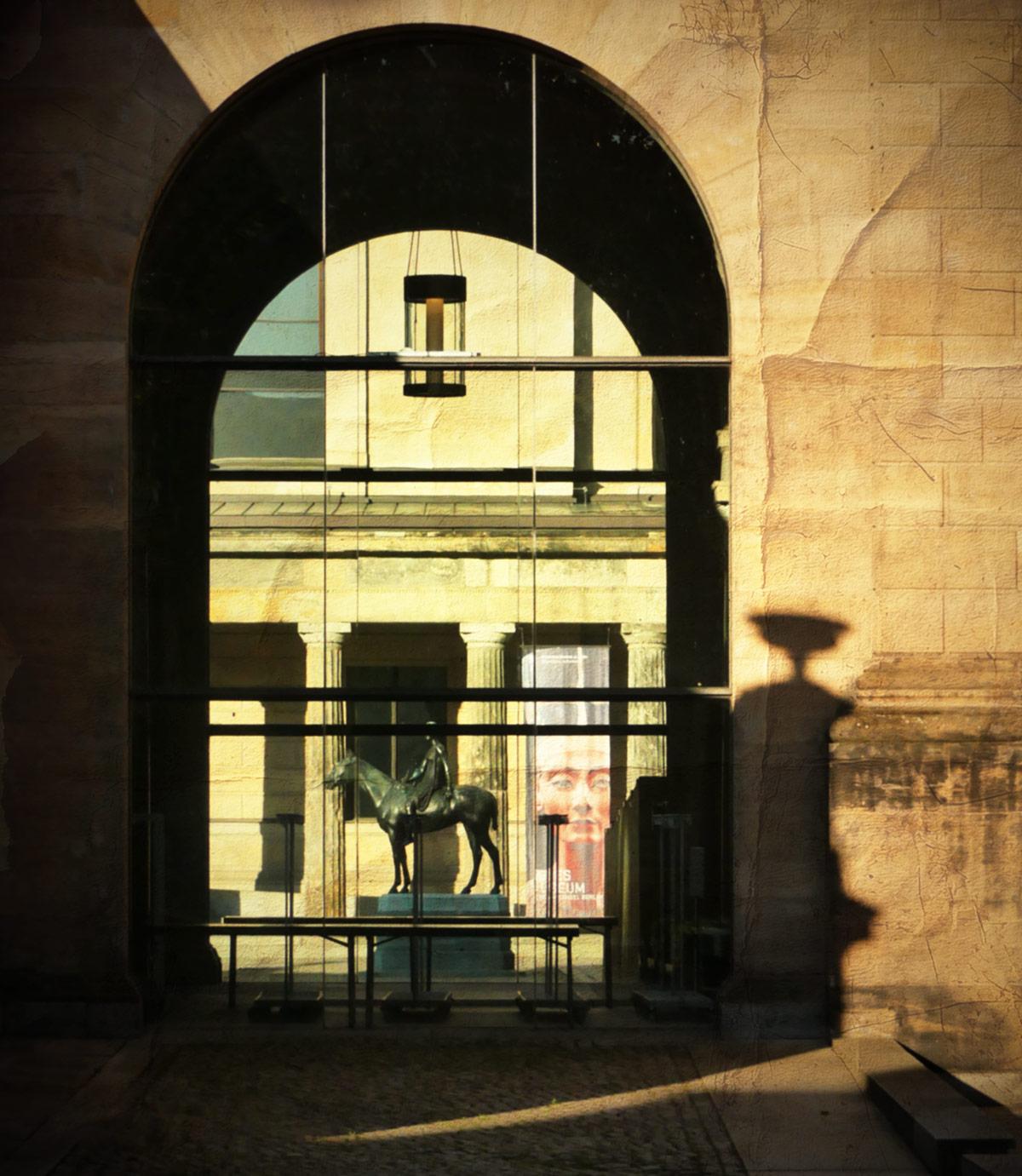
In an escape room, the set is fixed, built in a studio within a single closed room. Immersion is 100% controlled, with every detail thought out by the designers, but the world itself often remains fictional (secret laboratory, prison, haunted mansion…). In an outdoor escape game, the city itself becomes the set: real monuments, streets, and squares replace the studio. Immersion happens through contact with the real Berlin, with a storyline rooted in a true story from the city, such as the disappearance of the Nefertiti bust from the Neues Museum.
Playing Time
Here, a real difference comes into play. In an escape room, time is limited, often to 60 minutes: if you haven’t solved the case within the allotted time, you lose. Time becomes a central element of the stress and the game itself. While this can be frustrating, it also raises the challenge for some players. In an outdoor escape game, on the other hand, time is more flexible, usually between 2 and 4 hours: you move at your own pace, without the pressure of a countdown, and in most cases, you do solve the case.
Where Do You Play?
An escape room is played exclusively indoors, in a dedicated, themed room: this closed setting reinforces the immersion, with every corner of the room designed to pull you into the story. An outdoor escape game, on the other hand, is played outdoors, across several iconic locations in the city: you move on foot between the different points of the investigation, letting you explore the city while you play, rather than staying confined to a single location.
Weather and Accessibility
In an outdoor escape game, you play outside, and the scenery changes with the seasons, giving each investigation a different flavor depending on the day’s weather. The advantage of an escape room is that it’s playable all year round and doesn’t require extended walking.
The price
An escape room usually charges per person, between 20€ and 35€ per player: this fixed rate guarantees a calibrated experience regardless of the number of participants, and the higher costs of running an escape room (set design, maintenance, staff) justify this price. Outdoor escape games are often cheaper, with rates that vary depending on the format: app-based versions are generally the most affordable. Our outdoor escape game The Nefertiti Affair offers a single flat rate of 79€: you book the experience, whether you’re 2 or 6 players.
How Many Players?
An escape room usually accommodates 2 to 6 players, sometimes up to 8 depending on the room, with a fixed group once the booking is made: this contained size ensures everyone finds their place in solving the puzzles, without feeling lost in the crowd. An outdoor escape game is also usually played with 2 to 6 players, a format that works particularly well for families, couples, or small groups of friends: The Nefertiti Affair, for example, is played with 2 to 6 players, which gives you the freedom to split up the clues in the field while still keeping a real team dynamic.
Difficulty and Puzzle Quality
Puzzle difficulty varies a lot from one experience to another, whether in an escape room or an outdoor escape game. In an escape room, the short format (60 minutes) sometimes pushes designers toward very complex puzzles to fill the entire playing time, which can require fairly advanced, even somewhat abstract thinking depending on the room. In an outdoor escape game like The Nefertiti Affair, difficulty relies more on concrete physical objects and clues rooted in the location, with a progression designed to stay accessible without being too easy. In both cases, it’s worth checking the announced difficulty level before booking, to choose an experience suited to your group.

How to Choose the Right Adventure for You?
The right choice mainly depends on who you’re playing with and what you’re looking for from your outing.
For families, with children aged 7-8 and up, both formats work well, but the outdoor escape game offers an advantage: the absence of a countdown lets everyone take part at their own pace, without the pressure of a timer that can stress out younger players. Walking between locations also allows for a natural break if needed.
For a fun, intense moment with friends, a classic escape room is ideal if you have a limited time slot (an hour, no more) and you’re looking for the adrenaline rush that comes with a countdown.
For a weekend getaway or a way to discover the city, an outdoor escape game has the advantage of combining play and sightseeing: you don’t “lose” vacation time locked in a room, you discover Berlin while you play.
For corporate team building, both formats work well for group bonding. The escape room concentrates energy into a short time, practical for a tight slot between two meetings. The outdoor escape game, with its longer duration and movement between locations, encourages more informal exchanges between colleagues along the way.
As a couple, it all depends on the mood you’re after: the intensity of a countdown in a closed room for an escape room, or a shared stroll across the city for an outdoor escape game.
In every case, the most important thing is to check the announced difficulty level and the storyline description before booking, to choose an experience that truly matches your group’s energy and expectations.
Pros and Cons
- Fully controlled visual immersion, every detail of the set is carefully designed
- Short and intense format, ideal when your time is limited
- Playable all year round, in any weather, with no outdoor constraints
- Price per person stays fixed, no matter the size of your group
- Even when the theme is inspired by Berlin, you stay inside a recreated set, not the real city
- Authentic immersion in the real Berlin, not a studio recreation
- Time is on your side: 2 to 4 hours at your own pace, with no clock pressuring you
- Fixed price per team (79€): the more of you there are, the less it costs per person
- Depends on the weather, less comfortable in rain or heavy cold
- Involves walking between locations, to consider based on your group's mobility
Why Choose Our Outdoor Escape Game: The Nefertiti Affair?
After comparing both formats, one legitimate question remains: why choose this specific game over another? Here’s what sets The Nefertiti Affair apart in Berlin’s landscape.
First, its real anchoring in the city’s history. The investigation doesn’t take place in an imagined set, it’s built around real locations in Berlin Mitte, each chosen for its historical value and its coherence with the storyline. You don’t play in Berlin, you play with Berlin.
Then, the freedom of pace we covered earlier: no countdown putting you under pressure, just a 2 to 4 hour adventure you experience at your own speed, alone, as a couple, with friends, or as a family.
The price also works in your favor. At 79€ per team for 2 to 6 players, the more of you there are, the more affordable the experience becomes per person, a real advantage compared to the per-person rates of classic escape rooms.
Finally, language flexibility: the game is available in French, English, and German, making it an accessible option whether you’re an international visitor or a Berlin resident. Two time slots are offered each day, at 10am and 3pm, to fit your schedule.
Q&A
An escape room is played indoors, in a closed room, with a time limit of 60 minutes. An outdoor escape game is played outdoors, across several real locations in the city, with a flexible duration of 2 to 4 hours and no countdown pressure.
Yes, absolutely. Many players who find escape rooms too stressful or too complex enjoy the outdoor escape game precisely for its more relaxed pace and its puzzles rooted in real locations rather than an abstract set.
Yes, the game remains playable in all weather with the right clothing. It’s simply more comfortable in spring and summer, like any outdoor activity. In winter, playing in the snow can actually enhance the experience and change the atmosphere, just as autumn’s beautiful light and fallen leaves create their own mood.
If you’re playing with children, we recommend contacting the game masters to understand to what extent children can take part, as not all experiences are suitable for them. Adults should be available to help children solve the puzzles, and the amount of time available should be the deciding factor in your choice.
Yes, it’s recommended. With only two time slots per day (10am and 3pm), spots fill up quickly, especially on weekends.